
9 Top Colleges Families Overlook
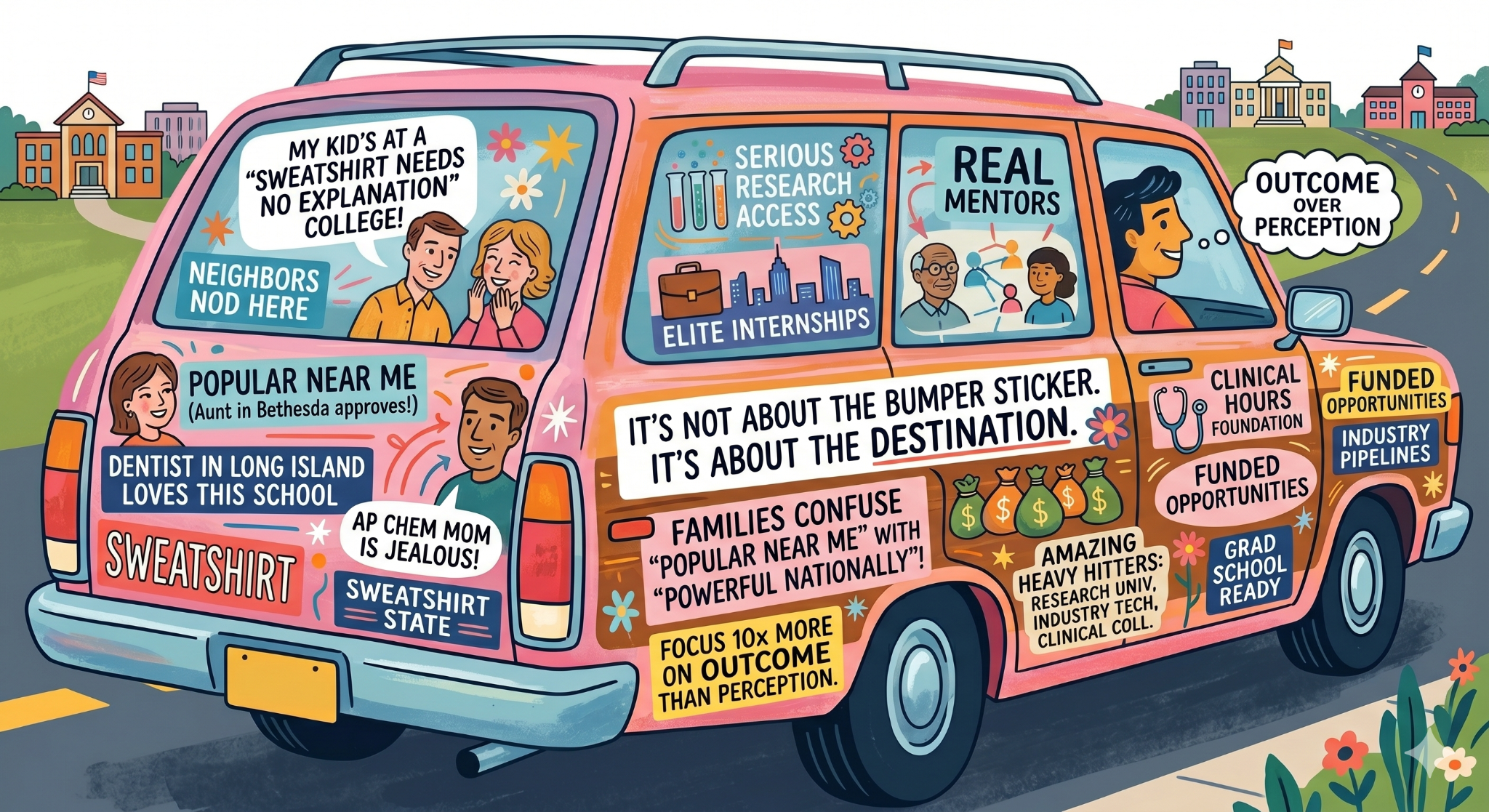
Families love a bumper sticker.
They love the school name that makes neighbors nod. The sweatshirt that needs no explanation. The college that makes other parents at graduation parties go, “Wow!”
I care less about whether your aunt in Bethesda, your dentist in Long Island, or the mom from your kid’s AP Chem class knows how impressive a school is.
Does the school give your student access to serious research? Elite internships? Real mentors, clinical hours, funded opportunities, industry pipelines, and grad school?
Sometimes families confuse “popular near me” with “powerful nationally.”
But the right college doesn’t always get the loudest reaction at dinner. Here are amazing (yet overlooked) heavy hitters I’ve been pushing to my students:
Harvey Mudd & Swarthmore
“Small” does not mean “soft.” These are not “cute liberal arts schools with some science.” For the right STEM kid, Harvey Mudd and Swarthmore are not a backup to the Ivies. They are often the smarter choice.
About 60% of Harvey Mudd seniors go straight into the workforce, with a median starting salary of $112,500. Close to 30% go directly into top PhD or master’s programs, often with full fellowships.
The Clinic Program is the real monster here. Harvey Mudd students work on industry-sponsored projects for actual companies and organizations. Current and past Clinic sponsors include names like Microsoft, Blue Origin, MIT Lincoln Laboratory, SpaceX, Google, you name it.
Meanwhile, Swarthmore is for the student who wants intellectual pain in the best possible way. Its rigor is widely respected by grad schools.
Swarthmore is one of the best schools in the country at producing students who go on to earn PhDs. Swarthmore students gain the technical credibility of an engineering degree, but they also learn to write, argue, think ethically, and explain complex ideas clearly.
These schools don’t just produce engineers who can calculate. It produces engineers who can think. Those engineers get hired.
Dartmouth
People know Darmouth is an Ivy, obviously. Yet less and less I find Ivy League-obsessed students applying early decision or even applying at all to Dartmouth at all. They often treat it like the “small outdoorsy one.”
Yet Dartmouth combines Ivy League academics with an unusually tight undergraduate focus. Professors know students. The campus is intensely residential. The alumni network is famously loyal.
Plus, I’d take Dartmouth’s D-Plan over Brown’s Open Curriculum.
Most colleges run on a normal calendar: fall semester, spring semester, summer break. Dartmouth runs on a quarter system, and students choose which quarters they want to be on campus and which to take off. They still complete their degree requirements, but they have more control over when they study, work, intern, travel, or do research.
A Dartmouth student can take an off-term in the winter or spring and pursue internships when the entire country is applying to the same summer opportunities. That can make it easier to land serious experience in finance, politics, media, research, or nonprofits.
Dartmouth is not as Providence-nondairy-cheese-shop as Brown. It is more residential, more tight-knit, more socially concentrated, and more discussion-heavy. They get academic agency, but inside a community where professors, peers, and systems are close enough to notice what they are doing.
Wellesley & Barnard
Families overlook women’s colleges for the dumbest possible reason: they think “women’s college” means smaller, softer, less powerful.
But access = power.
Wellesley’s outcomes are ridiculous, in the best way. For the Class of 2024, 97% of graduates were employed, in grad school, or doing service or military work within five months of graduation. And this is not just “they got jobs” energy.
Hillary Rodham Clinton. Madeline Albright. Nora Ephron. Diane Sawyer. Space Commander Pamela Melroy. Google Engineer Suzanne Frey.
Wellesley women end up in real positions of power. 10% of alumnae hold executive-level roles, and Wellesley graduates are extremely well represented in executive and government leadership.
And the internship support is massive. Wellesley funds over 250 students every summer so they can take serious internships around the world.
Meanwhile, Barnard gives students a tight, women-centered liberal arts college with access to the broader Columbia ecosystem in New York City. But people either underrate it as “not really Columbia” or misunderstand the relationship entirely.
Beyond Barnard facilitates funding for 500 internships per year, and the Beyond Barnard Internship Program provides funding and support for more than 250 students annually across fields.
At these schools, you build a professional life while still in college. Not theoretically. Literally.
Emory & WashU
Here is one of my spicier beliefs: for many pre-med students, the best choice is not automatically Harvard, Stanford, or the school with the shiniest general prestige.
Applying to medical school is brutal. They want GPA, clinical exposure, research, advising, MCAT performance, recommendations, maturity, and actual proof that the student understands medicine.
Emory gets pre-med in a way that a lot of Ivies, honestly, do not. At many elite schools, pre-med students are still fighting for the basics: clinical exposure, patient-facing experience, and anything that proves they understand medicine beyond getting an A in orgo.
At Emory, pre-meds train to become Certified Clinical Medical Assistants. They are not just shadowing a doctor and calling it “experience.” They are learning real clinical skills, patient care, and medical workflows. An Ivy might give you prestige, but Emory helps you build the kind of concrete healthcare experience med schools actually care about.
WashU gets pre-med because it treats it like a full four-year strategy, not a vague dream students are supposed to figure out alone. At many elite schools, pre-med advising can feel like, “Good luck, don’t let orgo destroy you.” WashU is much more intentional.
Their PreHealth advising starts early and keeps students on track with coursework, clinical experience, research, MCAT planning, and application timing. That matters because med school admissions is not just about being smart. It is about hitting every benchmark without accidentally ruining your GPA, missing key experiences, or applying before your file is strong enough.
An Ivy might give you prestige, but these schools give pre-meds a system.
Pepperdine & Santa Clara
Want to impress the counterlady at T.J. Maxx about where you went to college? Or to impress the person who will give you a job?
Pepperdine and Santa Clara are network schools. They have name recognition with the right people.
Pepperdine gives students access to Southern California’s wealth, entertainment, legal, and business ecosystem. Their law and business graduates are heavily concentrated in elite California firms (Abrams & Mayo, Lawyers for Justice, etc.). It is a strategic choice for students who want a high-net-worth network in a gorgeous, high-stakes environment.
Santa Clara gives students an insider trading pass for Silicon Valley. SCU students have alumni mentors from Apple, Google, Meta, and Nvidia who can grab lunch with them on a Tuesday and have them in a lab or an internship by Friday. The "friction to opportunity" ratio is the lowest in the country.
If you want your child to work in the C-suite of a tech company, you don't send them to a school where the alumni are 3,000 miles away. You send them to the person hiring for the internship, who is an alum who lives three blocks from campus.
It’s not about the bumper sticker.
It’s about whether the car will take you to the right spot.
Sometimes Stanford and Princeton are the best schools for one kid. But I believe we must focus 10x more on outcome than perception.
The point is not to reject prestige. (In fact, these schools are all prestigious, with whom matters most.) But you need a college list that is for your future, not someone's approval.
Post a comment