
Colleges Don't Trust Your GPA
This week, The Atlantic published a bombshell investigation into something admissions offices have quietly been dealing with for years: the number of top students with disability accommodations has exploded.
Not in a small way. Not in a fringe way. In a way that now reshapes how every application is read. Including yours.
At schools like Harvard University, Stanford University, Brown University, and UC Berkeley, between 20 and 45 percent of undergraduates now receive disability accommodations. It’s not that more kids are being born with physical impairments. Most of these students have ADHD, anxiety, and depression.
This is a massive increase over the past 10 to 15 years, and it is far higher than what we see at community colleges or less selective schools.
The Playing Field is Warped, Not Even
It is good that students with ADHD or anxiety are getting support they were denied for decades. That is not the problem.
The most common accommodation is extended testing time, and for many students, it is necessary. But extra time is not like a wheelchair ramp. Research shows it boosts grades even for students without disabilities.
Admissions officers now assume that a significant share of perfect GPAs involved extra time. Good grades no longer signal who performs best under pressure. They signal baseline academic readiness.
GPA Alone No Longer Separates You
Because of the increase in students who get test accommodations, colleges still care about grades, but they care far more about your application as a whole.
They look for students who succeed in environments that cannot be accommodated, who show sustained struggle followed by adaptation through projects, who reveal real complexity and introspection in their writing rather than just polish.
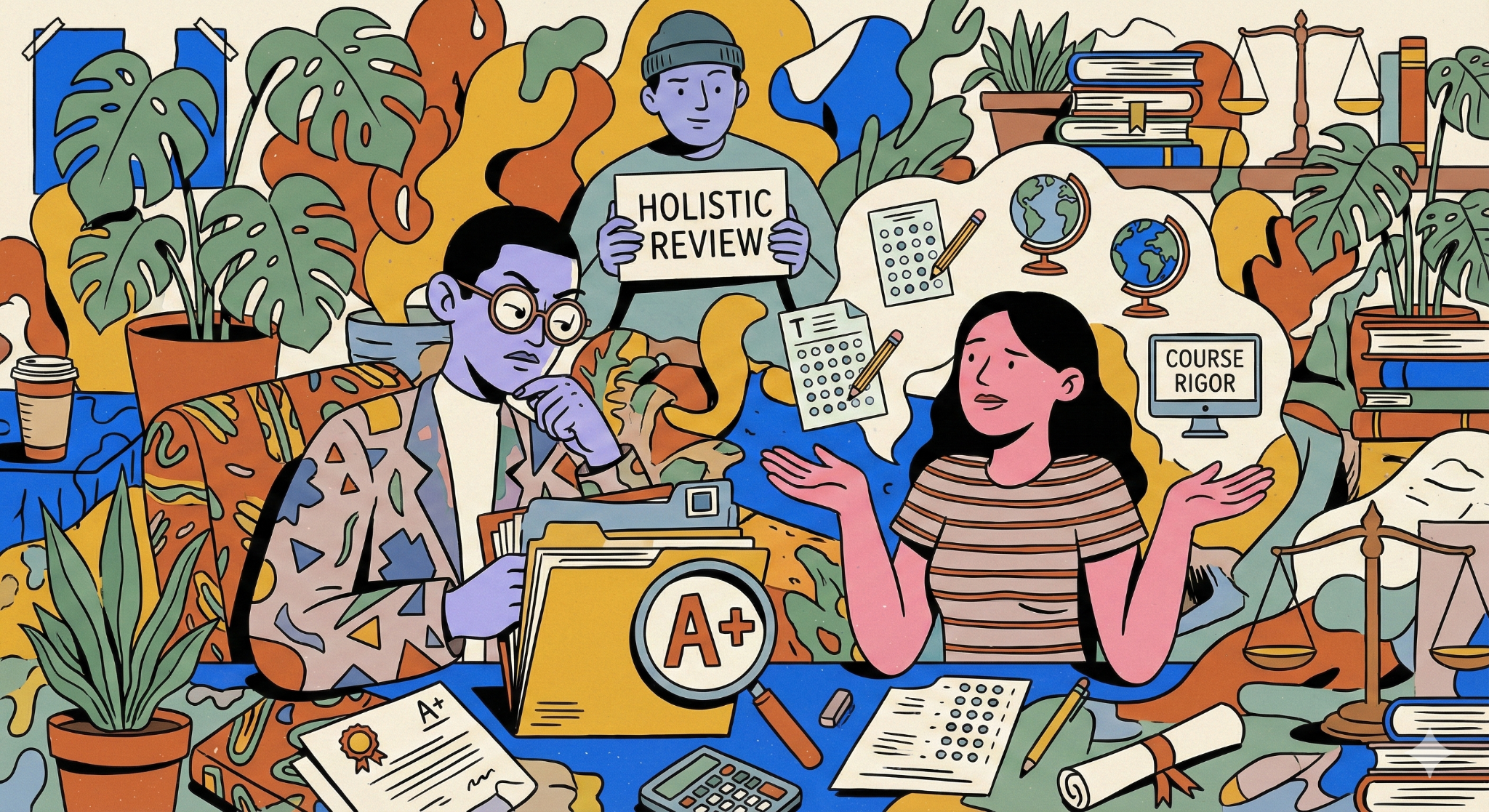
This is why they ask for more supplemental essays every year. Why they ask for graded papers in class. (They don’t trust the A+ your teacher gave for the essay!) Why activities matter more than ever. Why purely academic applicants who don’t have a compelling story can’t get in.
Top schools want proof you can think deeply, write long-form, have unique ideas, and yes, thrive when there are no accommodations.
If You Do NOT Have Accommodations
You are now competing in a pool where a large portion of A-students had 1.5 to 2 times the testing window. Raw score fairness no longer exists in the way families assume it does.
Your protection is no longer a high GPA. It is the story your transcript tells, the risk in your course choices, the courage in your ideas, and the long-form work that proves how you think when no clock is running.
If You DO Have Accommodations
When the disability is real, the pressure is real, too. Colleges will be quietly skeptical of your diagnosis. That doesn’t mean we should hide or prove it.
Instead, we need to prove your seriousness elsewhere, in how you think on the page, in how long you stay committed to an idea, and in whether the work actually belongs to you.
I’ve met many students whom I’ve begged to get tested. Those who really needed extra time for real disorders but didn’t want a shortcut. Very few abuse the system. They have to fight for a fair chance. But college admissions have never been fair. Universities are businesses, not holy ground.
It’s A Mess, But You’ve Got A Clean-up Crew
This is not a phase. This is the new architecture of admissions.
And this is exactly why Top Dog exists. We do not build applications that rely on speed, formulas, or résumé stuffing. We build long-form thinkers. We build risky intellectual projects. We build essays that demonstrate depth, not just polish. We build leadership with measurable stakes. Because that is what the system now actually rewards.
Oh, and we believe in our students, regardless of what accommodations they have or don’t.
I do not believe admissions is reasonable. It is a rigged game. But I like to win, and I play for my students to win with me.
Post a comment