
Dartmouth: The Ivy People Are Weirdly Sleeping On
People know Dartmouth is an Ivy, obviously. Nobody is sitting there going, “Dartmouth? Is that one of the SUNYs?” But I’m seeing more and more Ivy-obsessed students treat Dartmouth like the “small outdoorsy one,” while chasing Brown, Penn, Columbia, or Yale with the desperation of a Victorian orphan outside a bakery window. That is a mistake.
Dartmouth has something many elite colleges pretend to offer but often do not: real undergraduate attention. It combines Ivy League academics with an unusually tight undergraduate focus. Professors actually know students. The campus is intensely residential. The alumni network is famously loyal. Students are not just drifting through a giant prestige machine hoping someone important notices them before graduation.
I would take Dartmouth’s D-Plan over Brown’s Open Curriculum.
Brown gets all the branding credit for academic freedom. No core curriculum. No traditional distribution requirements. Build your own path. Be the architect of your education. Fine. Gorgeous. Very Providence-nondairy-cheese-shop. Brown’s Open Curriculum is real, and for the right student, it can be amazing. Brown officially requires students to complete at least 30 courses, fulfill at least one concentration, demonstrate writing competence, and complete the equivalent of eight full-time semesters, but it does not force students through a traditional core curriculum.
Course freedom is not the only kind of freedom.
Dartmouth gives students time freedom.
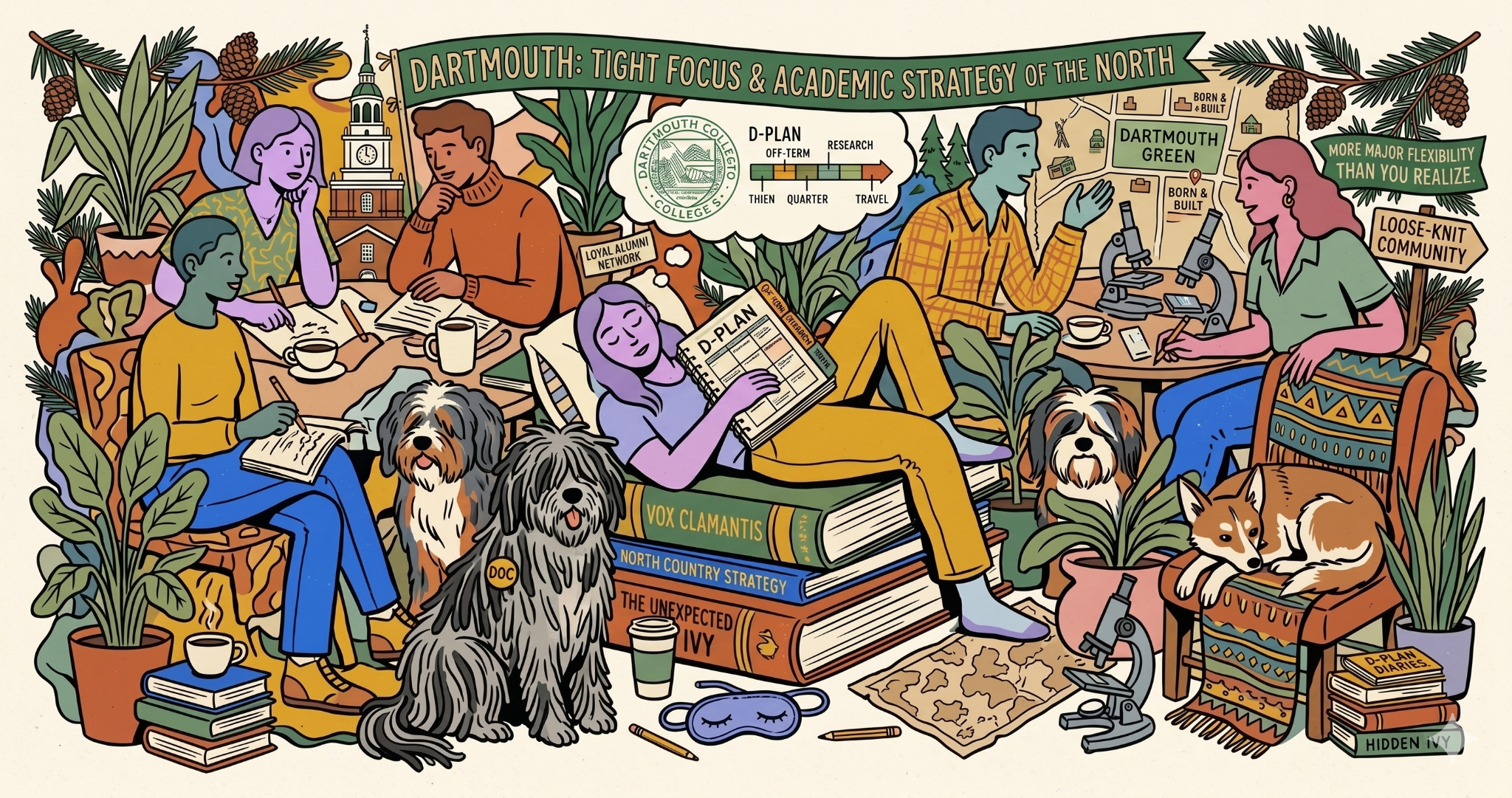
Most colleges run on the same tired calendar: fall semester, spring semester, summer break, everyone stampedes toward the same internships at the exact same time. Dartmouth does not. Dartmouth runs on a quarter system through the D-Plan, where students customize when they are on campus and when they are off campus, within certain guidelines. There are 15 academic quarters between matriculation and graduation, and most students take classes during 12 of them. Students are generally required to be enrolled during their first fall, winter, and spring; one summer term; and two terms of senior year.
A Dartmouth student can take an off-term in winter or spring and pursue internships, research, travel, political work, nonprofit experience, finance opportunities, media experience, or clinical exposure when half the country is not clawing for the same summer slot. That is not cute flexibility. That is strategic flexibility.
Brown lets you design your classes.
Dartmouth lets you design your year.
This is especially important for students who are trying to build a real profile before grad school, med school, law school, business, politics, research, or selective fellowships. The D-Plan gives students more room to move. You can study intensely, then leave campus for a serious opportunity, then come back and fold that experience into your academic work.
You are not just “exploring.” You are sequencing.
Brown’s Open Curriculum can sometimes become freedom in the abstract: take whatever you want, avoid what you hate, float around intellectually, call it self-discovery. That works beautifully for some students. But for others, especially students who need structure, mentorship, and actual momentum, it can become a very expensive choose-your-own-adventure book.
Dartmouth gives academic agency inside a tighter system. Yes, Dartmouth has distributive and world culture requirements, so it is not “open” in the Brown sense. Dartmouth students must complete general education requirements, including distributive areas and world culture categories like Western Cultures, Non-Western Cultures, and Culture and Identity. But I do not think that is automatically a weakness.
Dartmouth gives students flexibility without letting them disappear into total academic mush. There is room to explore, but there is also a coherent undergraduate structure. There are professors close enough to know what you are doing. There is a campus culture concentrated enough that your choices actually become visible. There is an alumni network that still behaves like a network, not just a logo on LinkedIn.
Dartmouth offers more major flexibility than you realize.
Students are not trapped in one narrow academic lane from age 18. The quarter system makes it easier to combine interests, pivot, add a minor, study abroad, do research, or use off-terms to test a career path before committing to it. That is the kind of flexibility I care about: not just “Can I avoid math?” but “Can I build an unusually strong, coherent, adult-looking undergraduate story?”
Dartmouth is not Brown with hiking boots. It is not the awkward rural Ivy hiding in the corner while the coastal schools get all the attention.
It is one of the best undergraduate experiences in the Ivy League, especially for students who want prestige, close faculty access, loyal alumni, serious community, and the ability to move through college with actual strategy.
Post a comment