Every Early Assurance Medical Program
Early assurance programs are the quieter cousin of BS/MD.
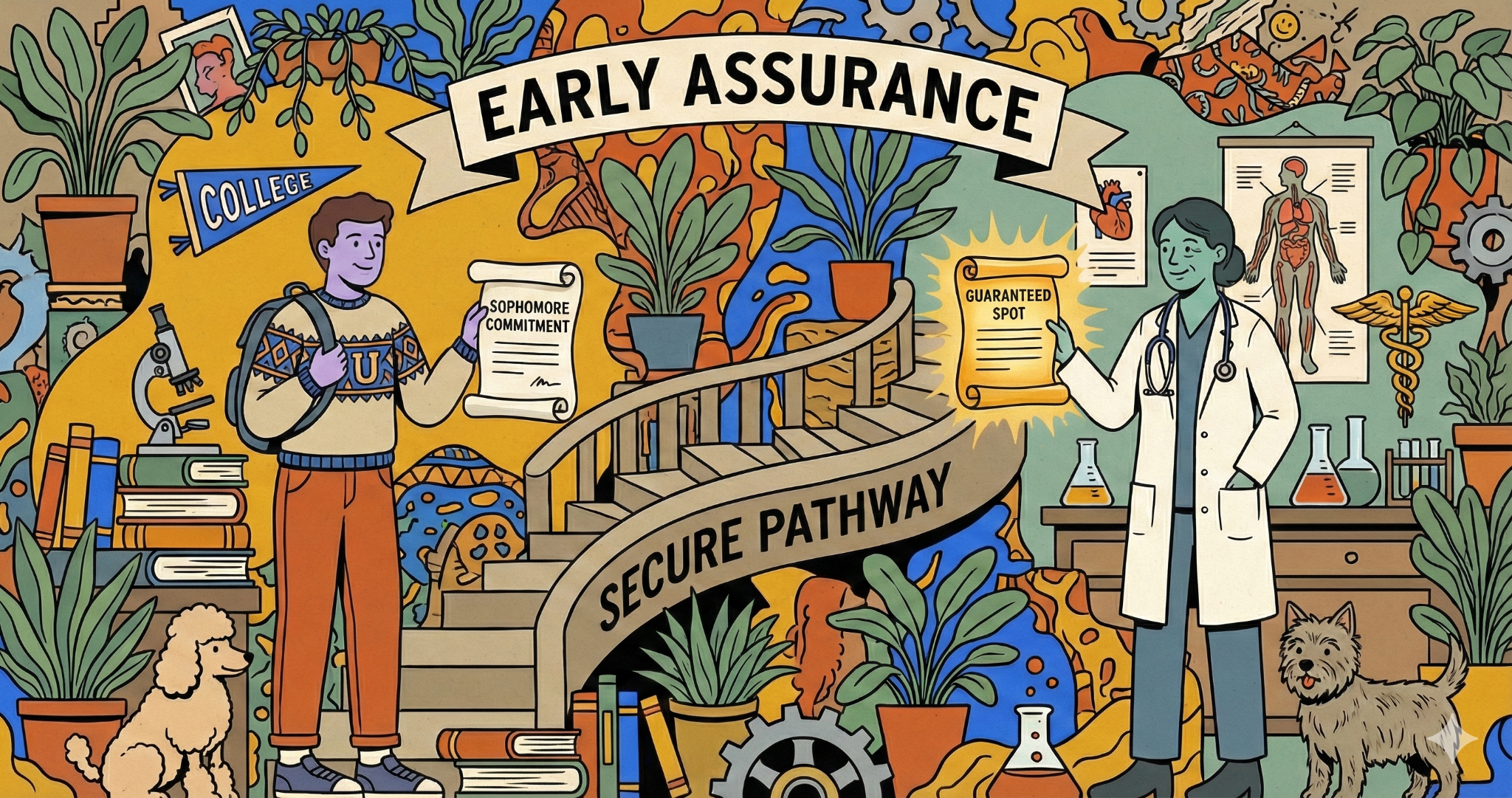
You apply as a college sophomore, not a high school senior. If admitted, you lock in a conditional seat at that medical school before the traditional med school cycle begins. No senior-year panic. No “submit 32 secondaries and pray.” Just keep your GPA strong, hit the program requirements, and you’re in.
Why are they appealing?
Relief. You survive the hardest premed classes first, prove you can actually handle college science, then secure your spot. No MCAT frenzy in some programs, or at least reduced pressure. You get to spend junior and senior year building depth instead of spiraling over acceptance rates.
Why are they competitive?
Because they want receipts. Not potential. You are now competing against top college premeds with real grades in organic chemistry, real research, real clinical exposure. Acceptance rates are still tiny.
You cannot “hope” to be a doctor. You need a transcript that says you are already in training.
Downsides?
You are tying yourself to one medical school. If you level up dramatically, you cannot shop your stats nationally. And if you underperform after getting in, some programs will absolutely rescind.
Early assurance is less teenage prophecy, more earned security. It rewards the disciplined, high-performing college student who wants stability without the med school Hunger Games.
Quiz: What's Your Med School Destiny? 🩺
Find out which of the 3 pathways to an M.D. you should be targeting right now—before you even step foot on a college campus.
Your Med School Strategy is Ready!
I've analyzed your answers and found the exact pre-med pathway you should target. Enter your email to reveal your results and example schools instantly.
We respect your privacy. No spam.
Your Ideal Pathway:
Example Programs to Target:
The Dream / Reach Example
The Strategic / Regional Powerhouse
The Strong Fit Example
Check your inbox! I'll be in touch soon. Reply to my email if you want help building a customized college list based on these results!
The "Big Name" University Programs
These programs are typically hosted by the university for its own undergraduate students.
Icahn School of Medicine at Mt. Sinai (FlexMed)
- The Vibe: This is arguably the most famous EAP in the country. It is designed for "intellectual explorers." They specifically want students who are majoring in the humanities, social sciences, or non-traditional fields. It is a very progressive, urban, and high-energy environment.
- Offerings: Once accepted, you are encouraged to stop focusing on traditional pre-med "box-checking" and instead dive deep into your specific passions (like history, music, or global policy).
- Time to MD: 8 years total (4 years undergrad + 4 years med).
- Competitive Stats: You apply in your sophomore year. You need a 3.5+ GPA (though 3.8+ is realistic) and high SAT/ACT scores (1500+/34+).
- The Catch: No MCAT required. In fact, they generally forbid you from taking it once accepted.
Northwestern University (NUPSP)
- The Vibe: Very professional, research-heavy, and academically rigorous. It appeals to the "high-achiever" who is already deeply embedded in the Northwestern ecosystem. It’s less about "exploring" and more about accelerating your path in a world-class research institution.
- Offerings: Direct entry into the Feinberg School of Medicine. It removes the competitive friction between peers because you are already "in."
- Time to MD: 8 years total.
- Competitive Stats: Apply in your junior year. You need a 3.7+ GPA.
- The Catch: No MCAT required, but it is only open to students currently enrolled at Northwestern.
Georgetown University (EAP)
- The Vibe: Deeply rooted in the Jesuit philosophy of Cura Personalis (Care for the Whole Person). The vibe is service-oriented, compassionate, and community-focused.
- Offerings: A seamless transition from Georgetown undergrad to the School of Medicine. They look for students who have shown a "calling" to medicine rather than just high test scores.
- Time to MD: 8 years total.
- Competitive Stats: Apply in your sophomore year. You need a 3.6+ GPA (with a focus on high grades in your science prerequisites).
- The Catch: No MCAT required. They want you to use your extra time for community service and social justice work.
Tufts University (EAP)
- The Vibe: Collaborative and "humanistic." Tufts has a reputation for being one of the more "friendly" medical schools. They value students who are well-rounded and have strong interpersonal skills.
- Offerings: A high-level advising track that bridges the gap between the Medford undergraduate campus and the Boston health sciences campus.
- Time to MD: 8 years total.
- Competitive Stats: Apply in your sophomore year. A 3.5+ GPA is required, but the average for accepted students is usually much higher.
- The Catch: Requirement for the MCAT varies by year; as of 2026, many students are still expected to show strong standardized testing aptitude even if the MCAT is waived.
Wake Forest University (EAP)
- The Vibe: Practical and clinical. Wake Forest is known for producing excellent clinicians. The atmosphere is southern-collegiate—polished but hardworking.
- Offerings: Students gain early access to clinical opportunities at the Wake Forest Baptist Medical Center.
- Time to MD: 8 years total.
- Competitive Stats: Apply in your sophomore year. You must have a 3.5+ GPA and have completed most of your core chemistry and biology sequences by the end of that year.
- The Catch: No MCAT required. This program is highly competitive because it’s one of the few elite schools in the South with this specific pathway.
University of Rochester (REMS)
- The Vibe: This is their "Rochester Early Medical Scholars" program. It is one of the most prestigious programs in the nation. The vibe is "academic freedom"—the school doesn't have a core curriculum, so they expect you to be a self-starter.
- Offerings: Combined BS/BA and MD. It is technically an 8-year program, but it is unique because you are accepted straight out of high school.
- Time to MD: 8 years total.
- Competitive Stats: Incredibly selective. You need a near-perfect high school GPA and top-tier SAT/ACT scores.
- The Catch: You must maintain a 3.5 GPA in college, but you are generally exempt from the MCAT.
Boston University (EMSSP)
- The Vibe: Mission-driven and diverse. This program is specifically designed to increase the number of underrepresented and disadvantaged groups in medicine.
- Offerings: A unique "consortium" model where you spend your first three years at a partner school (like Morehouse, Spelman, or Hampton) and then transition to BU for your senior year.
- Time to MD: 8 years total.
- Competitive Stats: Apply in your sophomore year at your partner institution.
- The Catch: MCAT is required, but the program provides significant support and resources to help you study for it.
Specialized & Regional Programs
These programs often have a specific mission, such as serving a specific region or increasing diversity.
- UC Riverside (Thomas Haider Program)
- The Vibe: Extremely mission-driven for the Inland Empire of California.
- Offerings: Specifically reserves seats for UCR undergraduates.
- Requirements: Must be a UCR student/alum. GPA 3.4+. No MCAT required if you haven't taken it yet.
- University of Florida (Med Honors)
- Vibe: Fast-paced and intense.
- Offerings: A 7-year combined program (7-year BS/MD). You apply in your sophomore year at UF.
- Requirements: 3.7+ GPA. High emphasis on clinical volunteering at Shands Hospital.
- Michigan State (CHM EAP):
- Vibe: Focus on rural and underserved medicine in Michigan.
- Offerings: Partners with several Michigan schools (Grand Valley, Hope College, etc.).
- Requirements: GPA 3.0+. MCAT required (minimum score ~506–510).
- Loyola Chicago (Stritch):
- Vibe: Jesuit values; deep focus on social justice and global health.
- Requirements: High GPA (3.7+) and a strong commitment to service. They typically require the MCAT.
Partner Schools & Historically Black Colleges (HBCUs)
These programs connect smaller liberal arts colleges or HBCUs to major medical centers.
Boston University (EMSSP)
- The Vibe: Diversity-focused. This is one of the most famous "consortium" programs in the US.
- Partner Schools: Hampton, Morehouse, Spelman, and several others.
- The Path: You spend your first 3 years at your home school, then your senior year at BU taking med-school-prep classes.
- Requirements: Apply sophomore year. 3.0+ GPA. Must take the MCAT but the "cut-off" is more flexible than standard BU admissions.
SUNY Upstate / University of Rochester Partnerships
- Partner Schools: Syracuse, Colgate, Hamilton, RIT, St. Lawrence, Skidmore, Wells.
- The Vibe: "The New York Connection." These programs aim to keep talent within the state.
- Requirements: * GPA: Usually 3.5+.
- SAT/ACT: Often require high high-school scores (1400+/31+) for early consideration.
- Offerings: Most allow you to bypass the MCAT if you maintain a high GPA throughout college.
Post a comment