
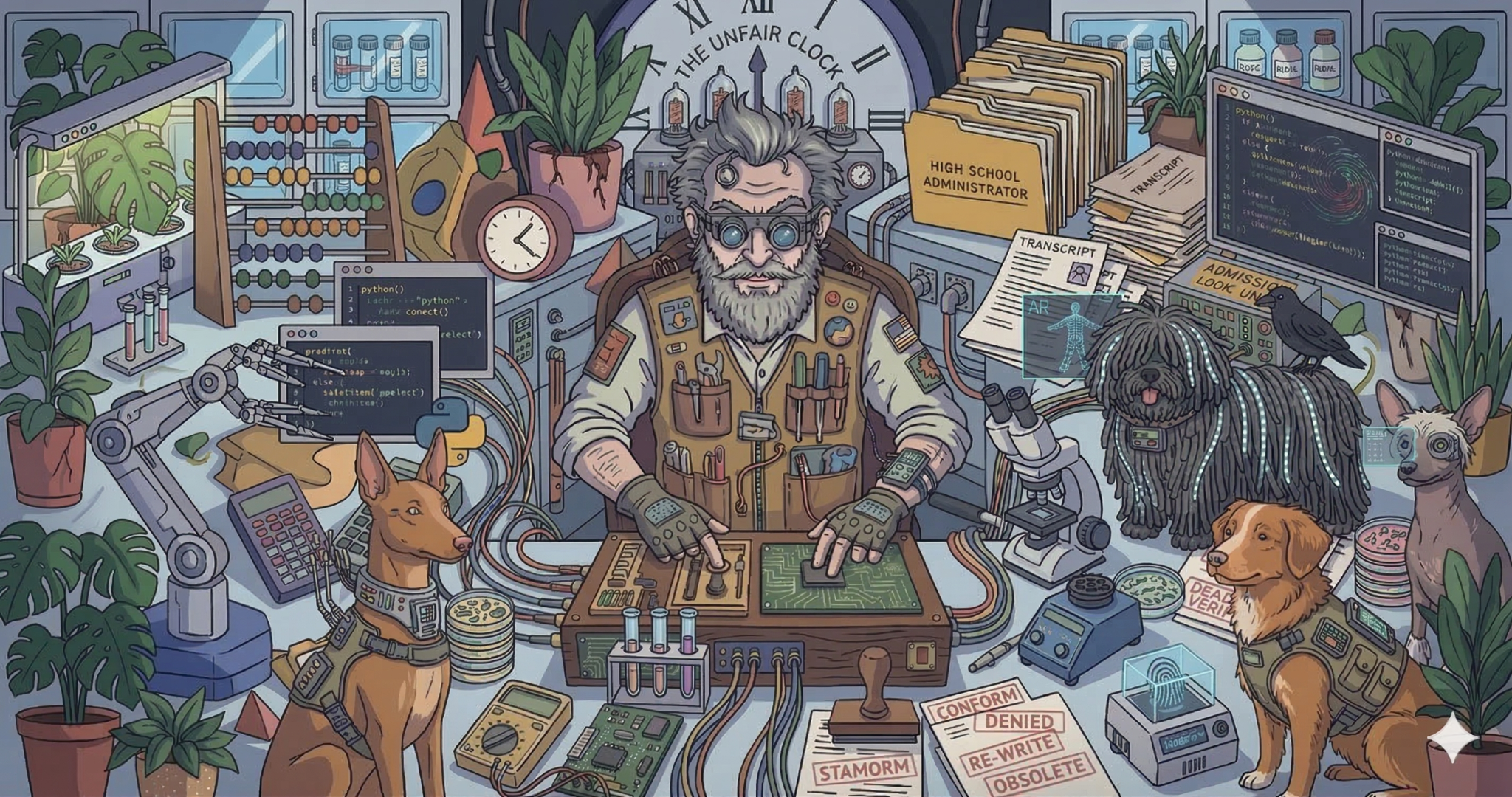
Hiring a STEM Specialist for College Admissions?
When a student wants computer science at Carnegie Mellon, engineering at Michigan, physics at Caltech, or anything remotely adjacent to the words “top STEM school,” families tend to do the same thing:
They go looking for a STEM specialist.
A software engineer. A doctor. A researcher. A coding mentor. Someone technical. Someone who feels safe.
It makes sense. It is also often the wrong hire.
Because knowing how to succeed in STEM is not the same thing as knowing how to get a teenager into a top college for STEM.
Those are two completely different skills.
The STEM Specialist Problem
A lot of so-called STEM college admissions gurus are really just adults projecting backward.
They think, “I got in, I built cool things, I know what matters.”
But they are a sample size of one.
They know how to do the work. That does not mean they know how to position a seventeen-year-old in one of the most competitive admissions environments in history.
They may have gotten in during a completely different era. They may have had flat essays, generic activities, or zero real narrative strategy, and still made it through. That is not expertise. That is anecdotal evidence with good branding.
What STEM Families Get Wrong
Students and parents often think the application is mainly about proving technical competence.
It is not.
At the top level, thousands of applicants are already technically competent. They already have the grades, the rigor, the projects, the research, the scores.
The real question is: can the application make the student feel vivid, specific, and worth betting on?
That is where most STEM applications die.
Not because the kid is not smart. Because the application has no pulse.
It sounds like a lab report with feelings.
Narrative > Skill
I have helped students get into Harvey Mudd, Caltech, Carnegie Mellon, the University of Michigan, Northwestern, Cornell, and Columbia for computer science, pre-med, engineering, and physics.
That's because I have a degree in screenwriting from the MIT of storytelling.
They were the ones building, coding, researching, competing, solving, obsessing.
I was the person who helped them tell the story of who they were, what made their mind interesting, and why their work mattered.
That is the job.
I was not there to explain their own projects back to them like a mediocre LinkedIn dad. I was there to identify the deeper pattern, sharpen the positioning, pull out the real personality, and make sure the application felt like a human being with a mind, not a résumé in a Patagonia vest.
Remember Who Is Reading
The admissions officer reading your undergraduate application is usually not a software engineer. Most are under 40 and have a degree in the humanities.
They are not there to marvel at the technical elegance of your codebase or faint over your differential equations.
They are asking something much more human:
Who is this student? What kind of mind do they have? What do they care about? What do they notice that other people miss? Would this person make our campus more interesting?
You do not get that across by sounding more technical.
The Best STEM Applications Do Two Things at Once
They prove rigor, and they create emotional clarity.
They show the student can do serious work, yes. But they also make the reader understand the person behind the work.
Why this field? Why this obsession? Why this student, specifically?
A technical mentor can help a kid build a stronger project. Great.
But if nobody helps that student interpret the project, connect it to identity, and write about it with specificity and intelligence, then the whole thing can still land dead.
A STEM specialist can help build the rocket. A strong admissions strategist makes the reader care who built it.
So, Should You Hire A STEM Admissions Expert?
Do not hire someone just because “engineer” or “doctor” makes you feel calm. Hire the person who understands how selective admissions actually works now.
Stop trying to sound impressive and start trying to sound true.
Your job is not to prove you are a tiny machine built in a magnet school basement.
You need to translate brilliance into narrative, rigor into identity, and achievement into an application that actually lives on the page.
Post a comment