
School Doesn't Matter As Much to Colleges As You Think
During my sophomore year of high school, everyone wanted to be a psychologist.
At least, you would assume so, since they all enrolled in AP Psychology as if it were their one true calling.
Why? “It’s an easy AP.” AKA — a college-level course that can boost their GPA and have a veneer of being a good student. Did they care at all about Carl Jung? No. But they felt it was required to be competitive.
Instead, I took creative writing, digital photography, chorus, and dance.
I don’t regret it. I majored in writing and have won prizes totaling more than $280,000 for my words. I became the yearbook’s creative director. And…you should see me wiggle and wobble at a party.
And I still got into numerous top-20 colleges. I received multiple merit scholarships, including two free rides. Because one class really doesn’t move the needle.
Students are too focused on school. There, I said it.
As someone who talks to high schoolers all day, I spend way too much time discussing schedules. Is AP Biology better than AP Chem? Should I take both to prove I am the pre-med God?
I’ve been guilty of this, too. I tried taking both the AP and non-honors English classes to prove I am a literary savant. Until I sat in the children’s literature class and was absolutely bored out of my not-so-Shakespearean skull. So, every other day, for the first time since middle school, I had a (shocking!) lunch period.
Schoolwork is not everything to colleges.
Yes, we want strong grades.
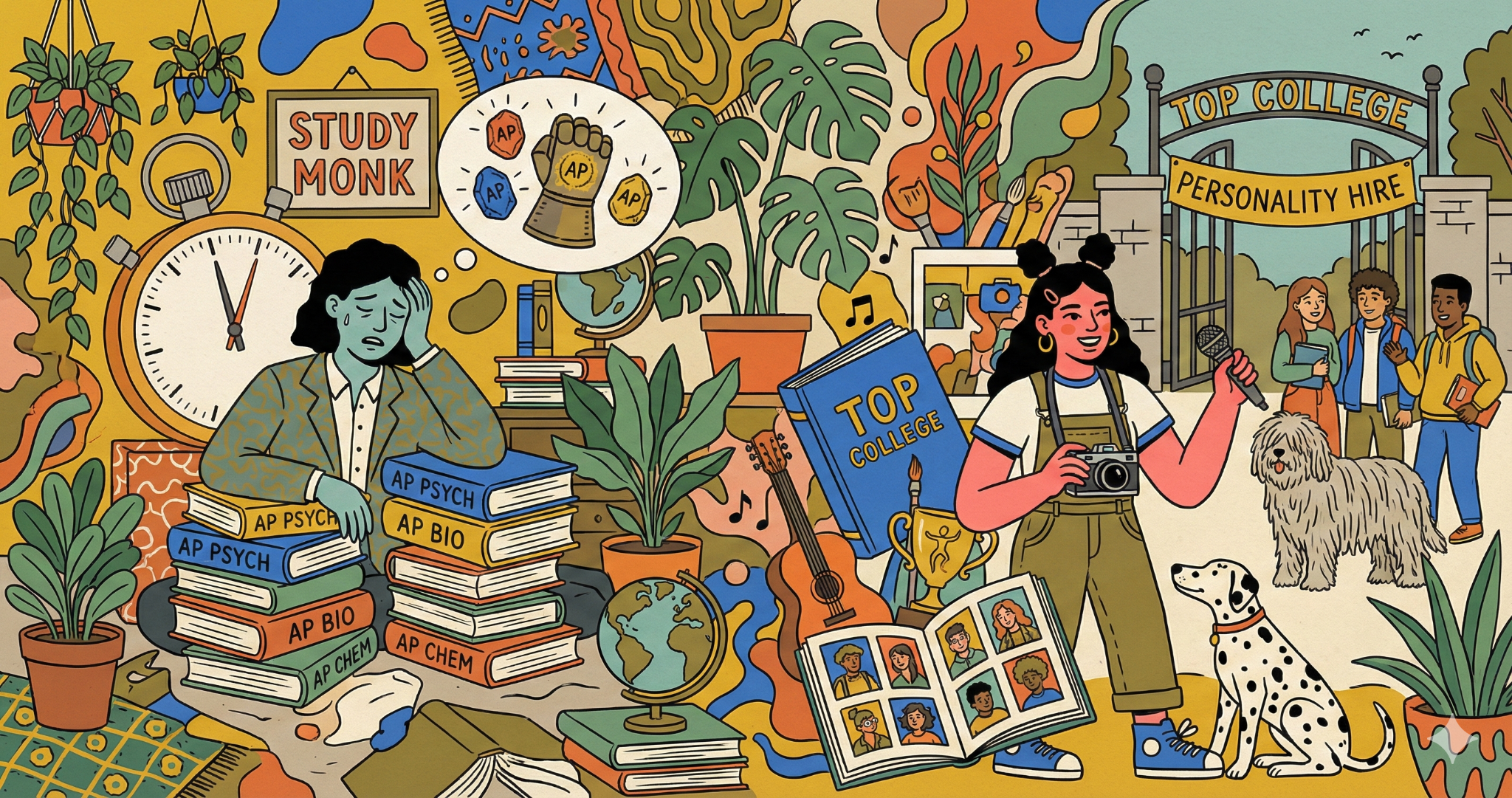
No, you do not need to collect APs like Infinity Stones.
Most students treat their transcripts like a video game. Unlock the Platinum Trophy. Max out the GPA. Collect all available badges.
But at schools like Harvard, Stanford, and MIT, academics are a threshold, not a differentiator. Once you’ve proven you can handle the work, adding a fifth or sixth AP offers sharply diminishing returns.
Harvard’s longtime Dean of Admissions, William Fitzsimmons, has publicly said that the majority of applicants are academically qualified to succeed.
If a school admits 5% of applicants but 70% of those applicants have near-perfect grades and top scores, the “tie-breaker” is not AP Bio vs AP Chem.
It’s who you are. It’s what you’ve built. It’s what happens when you enter a room.
You want to be the personality hire. The one who took digital photography seriously enough to overhaul the yearbook instead of just padding a GPA.
Your personality counts as much as grades.
This is proven by actual data. Colleges have common data sets where they explicitly say how they rank students and what criteria they evaluate. At places like Harvard, Yale, Stanford, MIT, you’ll see the same categories listed as Very Important:
• Academic Rigor
• Extracurriculars
• Character/Personal Qualities
• Essays
Notice: your essays, extracurriculars, and character count just as much as your classes.
More APs do not unlock a higher tier. They just eat up time from the other categories, which are equally weighted.
At a large state school, yes, you can sometimes brute-force your way in with a perfect GPA and 12 APs. Activities may be marked “Considered.” Character might matter less.
At selective schools, even public Ivies like the University of Michigan or UCLA, it flips.
A student with 10 APs and average activities loses to the student with 5 APs and exceptional impact. Every time.
Admissions counselors only glance over transcripts.
Many schools use an internal “Academic Index” (AI) to bucket students.
Once a student’s AI (a mix of GPA, Rigor, and Test Scores) passes a certain number, they are deemed “academically capable.”
At this point, the admissions officer stops looking at the transcript and moves to the Holistic files.
In many Harvard admissions lawsuits, internal documents revealed that students are rated on a scale of 1–4. A “1” in academics is great, but without a “1” or “2” in the “Personal” or “Extracurricular” categories, the student is almost always rejected.
MIT’s admissions blog is a goldmine for this. They explicitly tell students:
“Some students feel they need to take every AP offered to be competitive. This is not true... We would rather see you challenge yourself in areas you are passionate about than see you burnt out from a schedule that doesn’t leave room for anything else.”
Be a personality hire.
I’m serious. The bigger, bolder, braver you are as a person, the better college you’ll go to.
You’re directly being evaluated on your character as part of the process.
Colleges are currently facing a “loneliness epidemic” and mental health crisis on campus. They aren’t looking for “study monks” who spend 100% of their time on coursework.
When they look at your app, they’re asking: Will this student leave their dorm room? Can they handle a “B” without a breakdown? Can they work in a lab with others, or are they purely a competition fiend?
A student who takes 4 APs and spends 20 hours a week building something real, a nonprofit, independent research, a business, an art portfolio, a civic initiative, is far more predictive of future success than a student who spends those same 20 hours studying for a fifth and sixth AP exam.
Prove you can handle the work. Then use the rest of your time to become interesting, generous, curious, and imperfectly unique.
Take the class you actually care about.
Build the thing you can’t stop thinking about.
Leave space to breathe.
Don’t be exhausted. Be alive.
Post a comment