
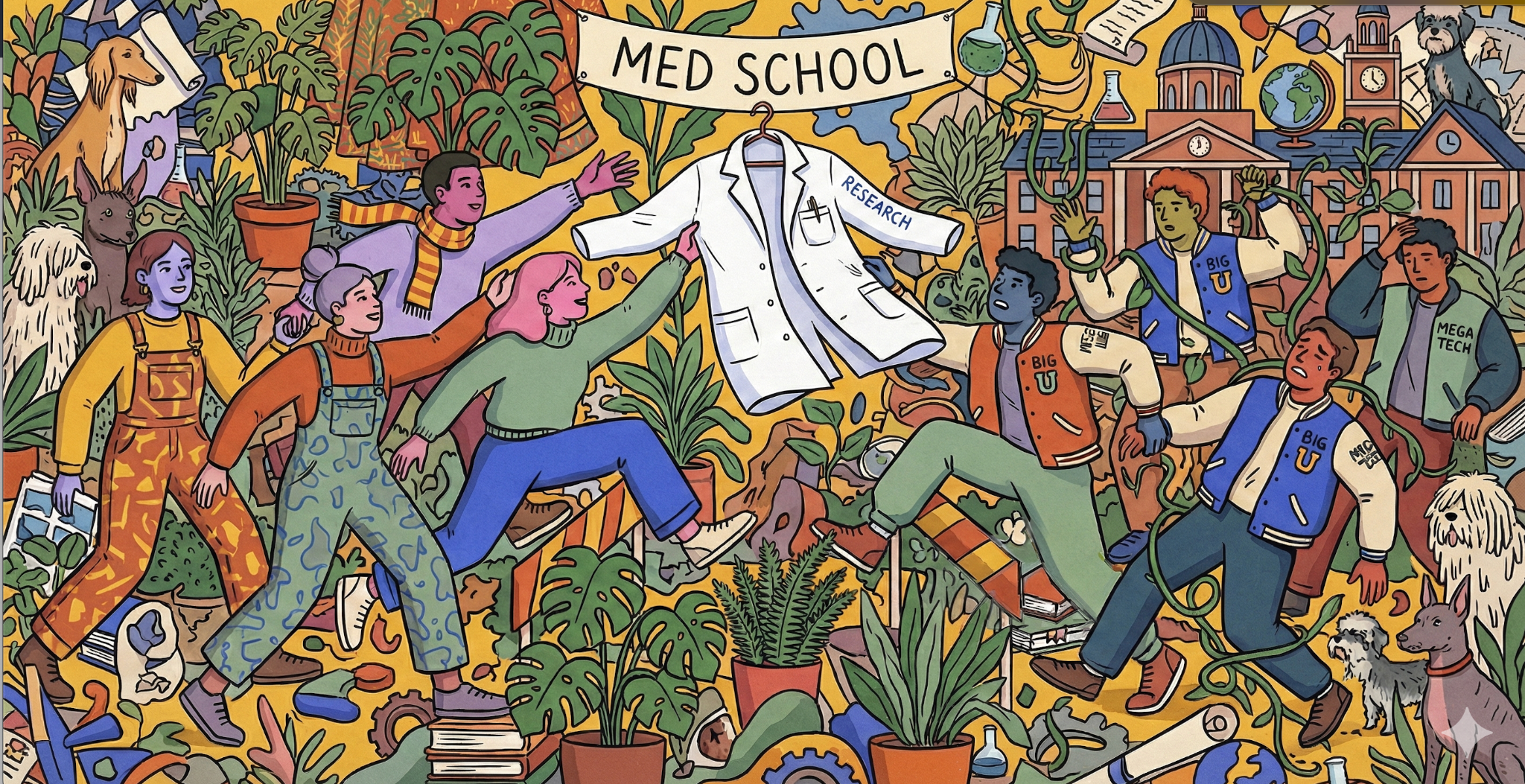
The Biggest Mistake Pre-Meds Make
Oh pre-meds.
You want to be a doctor. You want to spend as little time and money as possible getting there. You want certainty. You want prestige. You want “top research institution” on a sweatshirt.
And then you make the single most common mistake I see:
You ignore liberal arts colleges.
Not because they’re bad.
Because they’re small.
Because they don’t have a med school attached.
Because they “feel” less impressive than a massive research university. Yet...
Quiz: What's Your Med School Destiny? 🩺
Find out which of the 3 pathways to an M.D. you should be targeting right now—before you even step foot on a college campus.
Your Med School Strategy is Ready!
I've analyzed your answers and found the exact pre-med pathway you should target. Enter your email to reveal your results and example schools instantly.
We respect your privacy. No spam.
Your Ideal Pathway:
Example Programs to Target:
The Dream / Reach Example
The Strategic / Regional Powerhouse
The Strong Fit Example
Check your inbox! I'll be in touch soon. Reply to my email if you want help building a customized college list based on these results!
Liberal Arts College students are more likely to get into medical school.
The national medical school acceptance rate hovers around 42 to 45 percent.
Top liberal arts colleges routinely report acceptance rates between 70 and 90 percent.
Schools like Middlebury College, Bowdoin College, and Pomona College consistently publish med school acceptance rates in the 80 to 90 percent range for students who complete their pre-health requirements and advising process.
Elite universities like Stanford University or Duke University often fall in the 70 to 80 percent range.
Large state flagships? Typically 40 to 65 percent.
Now, yes. Liberal arts colleges have smaller applicant pools. Often fewer than 50 applicants per year. But that is the point. You are not lost in a sea of 800 pre-meds trying to survive Organic Chemistry.
Avoid pre-med weed out culture
At large research universities, intro Chem and Bio can have 400 to 600 students. Those classes are not built to support you. They are built to filter you. Professors are hired primarily for research output, grants, and publications. Teaching undergraduates is often secondary.
At a liberal arts college, your class might have 18 students. The professor knows your name. They hold office hours you can actually attend. They were hired because they care about teaching. The goal is mastery, not elimination.
At a big R1, graduate students and post-docs get priority in labs. Undergraduates often do support tasks. Important, yes. But rarely central.
At a liberal arts college, there are no PhD students. You are the researcher. You design experiments with faculty. You co-author papers. You present at conferences. That level of ownership matters enormously on a medical school application.
Better Research = Better Letters of Rec
Many liberal arts colleges have formal pre-health committees that produce composite letter. Not a generic “she did well in my class.” A deeply personal, narrative evaluation written by professors who have taught you in multiple small seminars and mentored you over years.
Medical schools read thousands of applications. A vivid, specific committee letter cuts through.
Med Schools love humanities.
According to data from the Association of American Medical Colleges, humanities majors often have acceptance rates around 52 percent. Biological science majors hover closer to 42 percent.
Read that again. And again. No, once more.
The English major who crushed the MCAT often outperforms the biology major who did the default track.
Why? Because medicine is not just content mastery. It is communication, empathy, ethical reasoning, and intellectual flexibility. Liberal arts colleges are built to train exactly that.
And here’s the psychological piece no one tells you:
At a massive university, you are competing against 800 other high-achieving pre-meds. You are average by definition.
At a small liberal arts college, you can be exceptional. You can be a visible leader. You can run organizations, lead research, build real faculty relationships.
Big fish + Small pond = Medical Coat.
Pre-meds obsess over proximity to medical schools. They think being near one is magic. It isn’t.
What matters is GPA, MCAT, research depth, clinical exposure, and letters that feel human.
You do not need a hospital next door. You need mentorship. You need attention. You need intellectual range. You need protection from a system designed to eliminate you before you even apply.
If you are serious about becoming a doctor, stop chasing the loudest name.
Start chasing the structure that statistically gives you the highest probability of admission. And if you need help getting into either, we're here.
Post a comment