
Business vs. Economics Major: Which Is Harder to Get Into?
Economics is everywhere. Every serious university has it. At places like Harvard, Yale, Princeton, and Stanford, there is no undergraduate business degree. If you want Wall Street, consulting, policy, whatever, you major in Economics. Period.
Business, on the other hand, is usually housed in a separate sub-school. Think Wharton School at Penn, Haas School of Business at Berkeley, Ross School of Business at Michigan, Stern School of Business at NYU.
And here is the part families miss: you are not just applying to “Penn.” You are applying to Wharton. You are not just applying to “Berkeley.” You are applying to Haas.
That sub-school is smaller. Capped. And significantly more competitive.
So what is harder to get into?
In most cases where both are offered, Business is harder.
Why? Because business schools cap enrollment. They have specialized career services. Smaller cohorts. Corporate pipelines. You are fighting for a specific seat in a specific building.
At places like NYU, Stern’s admit rate is dramatically lower than NYU overall. Same with Ross compared to Michigan’s general admission. Same with Haas compared to Berkeley overall.
Economics usually lives in the College of Arts and Sciences. That college is larger. The statistical barrier is lower. It is the “safer” door at most universities that offer both.
Now, before you misinterpret that.
At Ivies, Economics is not “easy.” It is just not capped in the same way. You compete for admission to the university, not for 300 seats in a business cohort.
So strategically, if your goal is maximizing odds of admission to a prestigious university, Economics is often the less bottlenecked path.
Both majors can land you at Goldman. Both can land you at McKinsey.
But they train you differently.
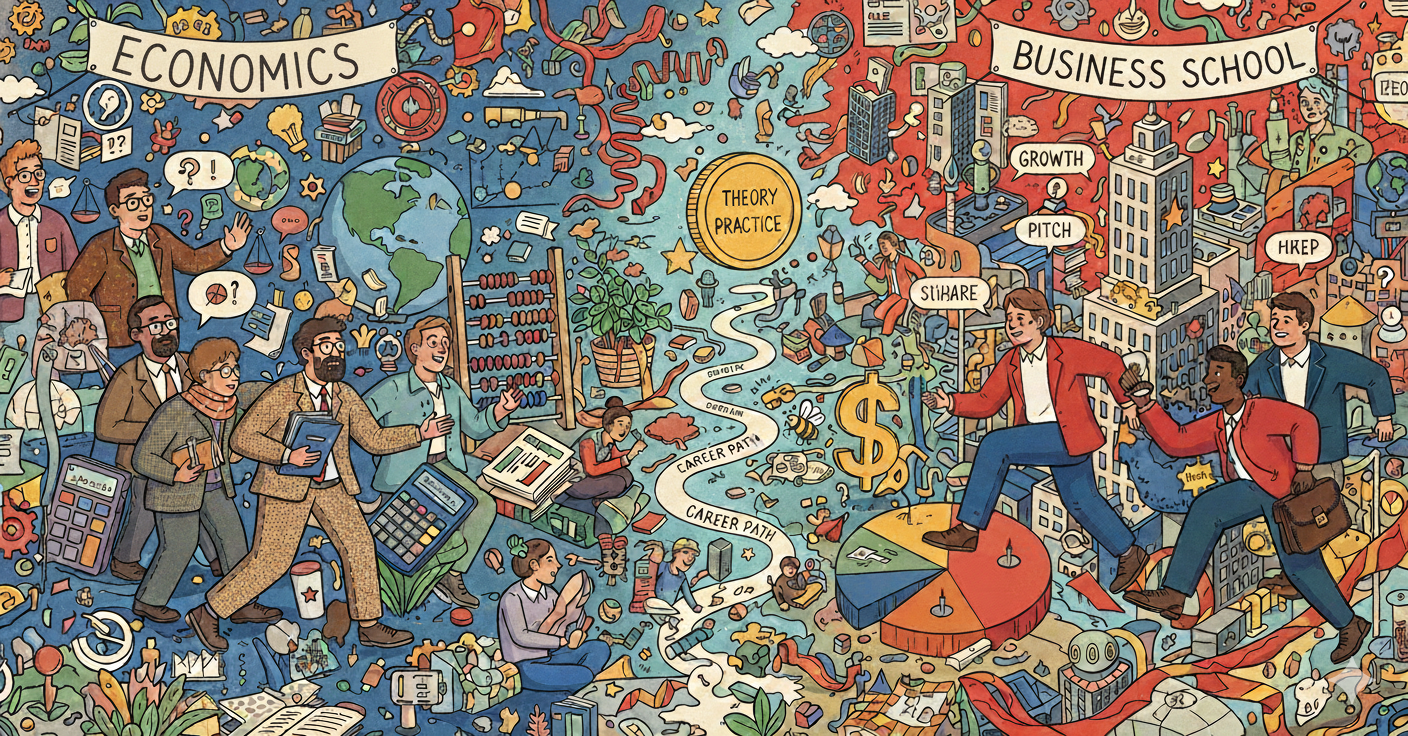
Economics is theory-driven. You study incentives, markets, game theory, econometrics. You ask why systems behave the way they do. You get comfortable with data and abstraction. It is a rigorous social science. At top schools, it is very math heavy. Calculus. Statistics. Regression analysis.
This path has a higher ceiling for graduate school. Law school. Policy. PhDs. Central banking. Research. High-level strategy.
Business is function-driven. You learn accounting. Corporate finance. Marketing strategy. Operations. You read balance sheets in class. You build financial models in class. You present constantly. You network constantly.
You graduate job-ready in a specific lane.
Economics teaches you how markets work.
Business teaches you how companies run.
School Name Matters More Than The Major
Especially in high finance and elite consulting. An Econ major at Princeton is not losing to a Finance major from a mid-tier school. Not even close.
Recruiters operate on target schools. If you are at Princeton, Harvard, Stanford, you are in the room. Those schools do not even offer business degrees. Economics is the default pipeline.
However, at schools that do have elite business programs, the internal hierarchy matters.
If you are at Penn, Wharton carries a different recruiting weight than Penn College of Arts and Sciences Econ. Not because Econ is weak, but because Wharton has a closed-loop alumni machine in private equity, hedge funds, and banking.
If you are at Michigan, Ross opens doors faster than LSA Econ.
At Berkeley, Haas has its own pipeline.
So the question becomes less “Which is better?” and more “Where are you applying and what ecosystem are you entering?”
How Do I Choose?
Choose Economics if you like the why. If you enjoy thinking about incentives, systems, policy, human behavior. If math does not scare you. If you want intellectual flexibility. If you might pivot to law, policy, research, or graduate school. If you prefer theory over “how to run a quarterly earnings call.”
Choose Business if you are career-specific. If you know you want accounting, corporate finance, brand management, or consulting. If you like collaborative projects and presentations. If you want structured recruiting pipelines starting sophomore year. If you care about immediate ROI and on-campus corporate access.
Do not apply Business just because it sounds prestigious. If your profile screams academic theory and you hate networking, you will be miserable in a hyper-professional program.
Do not apply Economics just because you think it is easier. At top schools, it is math-heavy and competitive. If you are weak in calculus and stats, it will expose you quickly.
The Major Is A Starting Point
If you are aiming for McKinsey, Bain, BCG, Goldman, JPMorgan, Blackstone, the name of the school will outweigh the name of the major nine times out of ten.
Wharton and Princeton Econ are gold standard.
Ross, Stern, Haas are specialist powerhouses.
Econ at a semi-target like UCLA or Boston College can absolutely work, but now you need a 3.7 plus GPA and aggressive networking.
Business is usually harder to get into because it is capped and professionally structured.
Economics is usually the more accessible door at universities that offer both.
But once you are inside a top school, your internships, GPA, and networking will matter more than whether your diploma says “Economics” or “Finance.”
Pick the major that matches your brain and your tolerance for math versus presentations.
Let us help you build a profile that makes sense for that choice.
Because nothing looks worse in admissions than a kid applying to Wharton who has never led anything, and nothing looks worse than a kid applying Econ who panics at derivatives.
Post a comment