The 10 Hardest College Programs to Get Into
Stanford. Princeton. Yale. We get it. The acceptance rates are microscopic. Your valedictorian cousin with the nonprofit and the 1580 is stressed.
But some of the hardest things to get into in American higher education are not colleges. They are elite, tiny programs buried inside colleges.
Here are the most brutally selective undergraduate programs in the country:
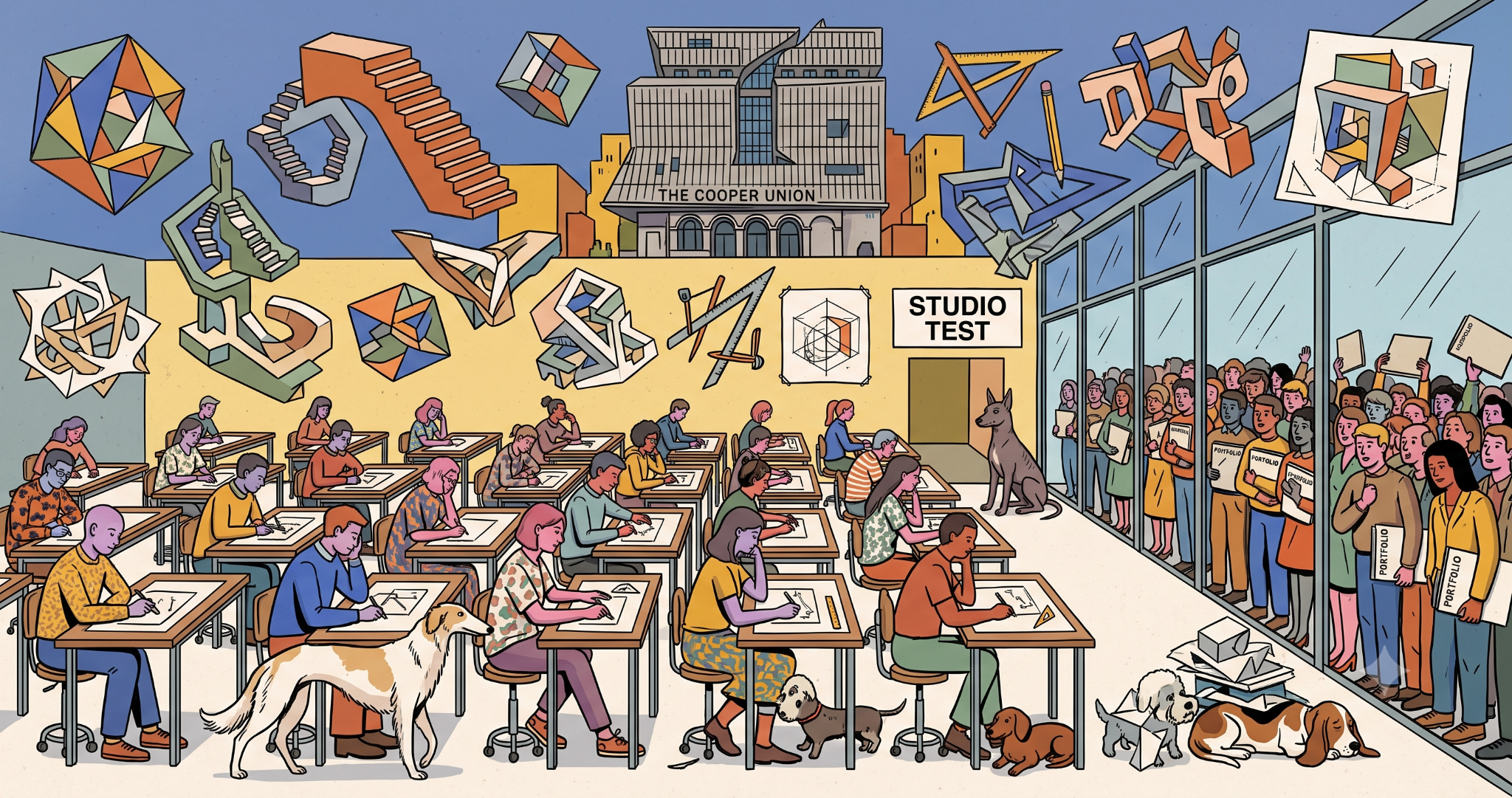
Cooper Union’s Architecture Degree
Acceptance Rate: ~4%
Class Size: ~30 students
The Irwin S. Chanin School of Architecture offers a five-year professional architecture degree. They don’t care about your high school art portfolio and with, they don’t have to.
To earn one of their seats, applicants must survive the legendary Studio Test: a grueling conceptual gauntlet that tests visual logic, spatial discipline, and raw imagination. Cooper Union strips away the noise of polished Canva decks and surface-level rendering. They aren’t looking for students who know how to make something look pretty; they are hunting for minds that already think like architects.
Juilliard’s Drama Division
Acceptance Rate: ~1.5–2%
Class Size: ~18–20 students
Juilliard Drama trains professional actors. Each year, roughly 2,000+ teens audition compete for fewer than twenty seats. Unlike traditional college admissions, where your transcript, essays, recommendations, and activities all get thrown into the holistic-admissions blender, Juilliard eventually comes down to one terrifying question:
Can you act?
Applicants survive multiple audition rounds testing things like emotional range, voice, movement, interpretation, and live stage presence.
You could have a 1600 SAT and a 4.0. If your audition dies in the room, so does your application.
Carnegie Mellon’s B.S. in Artificial Intelligence
Acceptance Rate: ~3–4%
Class Size: ~30–40 students
Computer Science at Carnegie Mellon is already insane. Then CMU apparently looked at that and thought, What if we made an even more elite version?
Carnegie Mellon was the first university in the country to offer an undergraduate degree specifically in Artificial Intelligence. The program lives inside its legendary School of Computer Science and enrolls a tiny cohort.
Strong applicants tend to have serious math preparation, advanced computer science work, research, technical projects, competitions, or some evidence that they actually understand the machinery underneath LLMs.
If your entire AI résumé is Python, AP Computer Science A, and a sentiment-analysis project you copied from YouTube, you are entering a knife fight with a pool noodle.
University of Pennsylvania’s M&T and Huntsman Programs
Penn is already extremely hard to get into. Wharton, its top business school, is even worse. Then Penn created tiny programs for students who apparently looked at getting into one elite school and said, No thanks. Please make me qualify for two simultaneously.
Jerome Fisher Program in Management & Technology
Acceptance Rate: ~3%
Class Size: ~50–55 students
M&T lets students earn two degrees at the same time: one from Wharton and one from Penn Engineering. Translation: Penn wants teenagers who are exceptional at both business and engineering.
Successful applicants often combine elite math and science preparation with evidence that they actually build things, launch things, research things, or lead serious technical projects.
Huntsman Program in International Studies & Business
Acceptance Rate: ~3%
Class Size: ~50 students
Huntsman is another dual-degree program. This one combines Wharton business with international studies and advanced foreign-language study.
You need the academics and leadership expected of a Wharton applicant plus serious language ability and a profound passion for international economics, politics, and culture. Huntsman wants future national bank presidents who can genuinely explain how business interacts with governments, markets, languages, and cultures across borders.
UC Berkeley’s Management, Entrepreneurship, & Technology Major
Acceptance Rate: ~1.5–3%
Class Size: ~45–50 students
Berkeley M.E.T. is basically California’s answer to Penn M&T.
Students earn two degrees simultaneously: one through the Haas School of Business and another through UC Berkeley’s College of Engineering. (For a state school price!)
Which sounds amazing until you realize Berkeley receives a biblical number of applications every year and M.E.T. admits roughly enough students to fill one moderately crowded classroom.
M.E.T. is looking for the rare teenager who can survive Berkeley engineering and understand what should actually be built, who wants it, and how to bring it into the world. If your entrepreneurship story begins and ends with DECA, you have company. Unfortunately, your company is approximately 9,000 other applicants.
UT Austin’s Turing Scholars
Acceptance Rate: Extremely Low, Especially Out of State
Class Size: ~50 students
People see “public university” and mentally file it somewhere below Stanford-level insanity. But by law, UT Austin heavily prioritizes Texas residents. So if you live outside Texas, you are already competing for a much smaller share of seats.
Then add computer science, one of UT’s most coveted majors. Then add Turing Scholars, an honors program within computer science for unusually advanced students interested in research, theoretical computer science, and higher-level mathematics.
These applicants are not just vibe-coding apps. They are doing algorithms, research, competitions, advanced math, sophisticated independent projects, or things that make normal seventeen-year-olds look suspiciously well-adjusted.
For an out-of-state applicant, this can become one of the nastiest admissions equations in the country.
USC’s Writing for Screen & Television BFA
Acceptance Rate: ~3%
Class Size: ~26 students
USC has tens of thousands of students. The undergraduate screenwriting program takes roughly 26 a year. This major is a dinner party.
USC’s John Wells Division of Writing for Screen & Television is a conservatory. Unlike most college majors, you have to prove you can actually write before USC lets you in.
The application alone scares away plenty of people. Applicants must write two film scenes, submit a writing portfolio, and a creative portfolio listing everything they’ve ever made. Plus, you have to have the academic chops to get into the University of Southern California itself.
The curriculum itself is identical to their graduate program. So USC is scouting 18-year-olds with the talent of their famous alumni: John Singleton, Stephen Chbosky, John August, Shonda Rhimes, and Judd Apatow.
Brown’s Program in Liberal Medical Education
Acceptance Rate: ~2–2.3%
Class Size: Roughly 60–80 students
Normally, becoming a doctor works like: You apply to college at seventeen. Spend four years there. Take the premed requirements. Take the MCAT. Then apply to medical school and pray all over again.
Direct-med programs let you apply as a high school senior to medical school. No application process. No MCAT requirement.
Naturally, direct-med programs like this are already a bloodbath. As the only program of its kind in the Ivy League, PLME sits near the top of the food chain.
You must be good enough to get into an Ivy League school and into their med school at the same time. Then show the maturity to know exactly what specialty you will practice, what patients you will treat, and what your medical career will look like.
Johns Hopkins’ Biomedical Engineering
Acceptance Rate: ~4%
Class Size: ~120–140 students
Johns Hopkins is already synonymous with terrifying premed students. Then there is BME.
Biomedical engineering basically sits at the intersection of medicine and engineering: think medical devices, imaging technology, prosthetics, computational biology, and other ways engineering can solve medical problems.
At Hopkins, BME has its own extremely competitive selection process.
Saying "I like biology and math" is adorable, but it won't get you past the threshold. Your competition isn't just taking AP Calculus; they are publishing computational biology papers, designing medical devices, and conducting university-level research.
USC’s Iovine and Young Academy
Acceptance Rate: ~3–5%
Class Size: ~25–30 students
This is basically the college version of a startup incubator.
Created with support from music titans Jimmy Iovine and Dr. Dre, the Academy combines technology, design, business, communication, and entrepreneurship. Instead of choosing between “creative kid” and “business kid” and “tech kid,” Iovine and Young basically asks: Why not be all three?
It attracts the kind of teenager who has somehow launched a clothing company, coded an app, designed a sneaker, edited a documentary, and raised $17,000 on Kickstarter before prom.
Applicants submit portfolios and video materials and may go through interviews or pitch-style evaluations. Every teenager with twelve unrelated extracurriculars thinks they are multidisciplinary. IYA wants people who combine disciplines to make money.
Acceptance rates are wildly misleading.
A university might admit 10% of applicants overall while your program admits 3%.
What you apply as matters as much as where you apply. The tiny program hiding inside the supposedly “easier” college can be harder to crack than Harvard!
I do not believe in handing a student twenty famous universities, looking up their acceptance rates, and sorting them into reach, target, and safety.
Sometimes I tell a student to apply to the terrifying 2% program because their profile is bizarrely perfect for it. Sometimes I tell an objectively incredible student that the 15% school on their list is actually one of their biggest reaches because of the major they picked.
We know an unhealthy amount about individual colleges, majors, honors programs, direct-med programs, dual degrees, weird institutional priorities, and the tiny admissions traps. You need to know those things too.
Post a comment